
GLP-based medications are used in medical weight management and metabolic care. These treatments act on hormone pathways involved in appetite, fullness, digestion, blood sugar regulation, and energy balance. At Quick Start Medical Weight Loss & Wellness, patients often ask about the differences between single-pathway GLP-1 medications, dual-pathway medications, and emerging triple-pathway therapies. For educational purposes, Quick Start refers to these categories as QS-GLP1-S, QS-GLP2-T, and QS-GLP3-R. Because triple-pathway therapies remain an evolving area of research, availability and treatment eligibility should be discussed directly with a medical provider.
Understanding Single, Dual, and Triple Pathway Medications
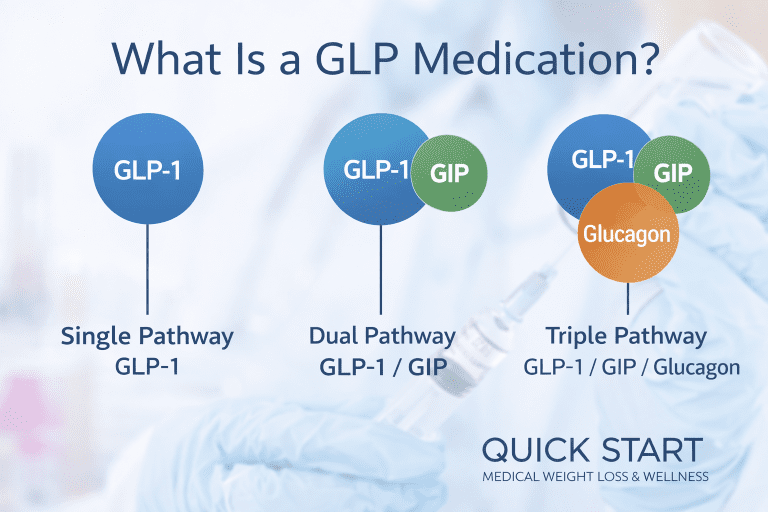
GLP-based therapies can be grouped according to the number of hormone receptors they activate. Some medications target the GLP-1 receptor alone, while others activate two or three related pathways involved in appetite, blood sugar regulation, and metabolism.
These medications are commonly described as single agonists, dual agonists, or triple agonists. A greater number of targeted receptors does not automatically make one treatment appropriate for every patient. Medication selection should be based on the patient’s health history, treatment goals, potential risks, and the provider’s clinical judgment.
Single Pathway GLP-1 Medications
Single pathway medications activate the glucagon-like peptide-1, or GLP-1, receptor. GLP-1 receptor agonists may help reduce appetite, increase feelings of fullness, slow stomach emptying, and support glucose-dependent insulin release.
Semaglutide and liraglutide are commonly discussed examples in this category. In major clinical trials, average weight loss varied according to the medication, dosage, treatment duration, and patient population. Adults receiving liraglutide lost an average of approximately 8 percent of their body weight in one trial, while adults receiving weekly semaglutide lost an average of approximately 15 percent in another. Individual results vary and no amount of weight loss can be guaranteed.
Quick Start uses the following treatment label for this category:
QS-GLP1-S Peptide
Dual Pathway GLP-1 and GIP Medications
Dual pathway medications activate both the GLP-1 and glucose-dependent insulinotropic polypeptide, or GIP, receptors. Activating both pathways may help regulate appetite, feelings of fullness, glucose response, and other metabolic processes.
Tirzepatide is the best-known medication in this category. In a major obesity trial, adults receiving the highest studied dose experienced an average body weight reduction of approximately 21 percent. Tirzepatide is FDA approved for chronic weight management in qualifying adults under the brand name Zepbound. Results vary based on dosage, treatment duration, adherence, medical history, and other individual factors.
Quick Start uses the following treatment label for this category:
QS-GLP2-T Peptide
Triple Pathway GLP-1, GIP, and Glucagon Medications
Triple pathway medications are designed to activate three receptors: GLP-1, GIP, and glucagon. Researchers are studying whether activating these pathways together may affect appetite, glucose regulation, energy expenditure, and other metabolic functions.
Retatrutide is the best-known investigational medication in this category. Clinical trials have reported substantial average weight reduction and improvements in certain cardiometabolic measurements. However, retatrutide remains an investigational medication and is not FDA approved. It should not be presented as an available or approved weight loss treatment.
Quick Start uses the following educational category label:
QS-GLP3-R Peptide
This label should be used only when discussing emerging research unless and until retatrutide receives FDA approval and becomes legally available for clinical use.
How the Categories Compare
The categories can be understood in the following way:
- Semaglutide and liraglutide primarily activate the GLP-1 receptor.
- Tirzepatide activates both the GLP-1 and GIP receptors.
- Retatrutide is being studied for its activity at the GLP-1, GIP, and glucagon receptors.
Some trials have reported greater average weight reduction with dual and triple receptor medications than with earlier single receptor therapies. However, results from different clinical trials cannot be treated as a guaranteed ranking for an individual patient.
A medication that produces greater average weight loss in a study may also have different risks, side effects, contraindications, dosing requirements, and monitoring needs. The best treatment is the option that is medically appropriate for the individual patient.
Why Patients Are Interested in Triple Pathway Research
Triple pathway research has attracted attention because it combines appetite-related signaling with additional pathways involved in glucose regulation and energy metabolism.
Retatrutide is being studied as a once-weekly medication for obesity and related metabolic conditions. Recent clinical trial results have been promising, but research and regulatory review are still ongoing. Retatrutide remains investigational and is not currently an FDA-approved treatment.
Patients should be cautious of businesses or online sellers claiming to offer retatrutide outside a legitimate clinical trial. Investigational products marketed as retatrutide have not been reviewed by the FDA for safety, effectiveness, quality, or authenticity.
Common Side Effects to Know
Gastrointestinal symptoms are among the most commonly reported side effects of approved GLP-1 and dual pathway medications. These may include:
- Nausea
- Diarrhea
- Constipation
- Vomiting
- Abdominal discomfort
- Indigestion
- Feeling overly full
Symptoms may be more noticeable when treatment begins or when the dosage increases. FDA prescribing information for semaglutide and tirzepatide also contains important warnings, precautions, contraindications, and potential adverse reactions that should be reviewed with a qualified medical provider.
Medical supervision matters because a safe treatment plan involves more than choosing a medication. It also includes selecting an appropriate dosage, increasing it carefully when indicated, monitoring the patient’s response, managing side effects, and determining whether treatment should continue.
Important Information About Compounded GLP Medications
Compounded medications are not FDA approved. The FDA does not review compounded products for safety, effectiveness, or quality before they are marketed.
The FDA has also warned patients and healthcare providers about dosing errors, fraudulent labels, quality concerns, and unapproved versions of semaglutide and tirzepatide. Patients should obtain medication only through a licensed provider and appropriately licensed pharmacy.
Bringing It All Together
Single, dual, and triple pathway medications activate different combinations of receptors involved in appetite and metabolism.
Single pathway medications activate GLP-1. Dual pathway medications activate GLP-1 and GIP. Triple pathway medications are being studied for their activity at GLP-1, GIP, and glucagon receptors.
More pathways do not necessarily mean a medication is safer, better, or more appropriate for a particular patient. Approved treatment options should be selected through an individualized medical evaluation. Emerging medications such as retatrutide should be discussed as research developments rather than currently available treatments.
GLP Medication Support in Pace, Florida
Quick Start Medical Weight Loss & Wellness provides personalized consultations for patients interested in learning about medically supervised weight loss options.
During your consultation, your provider can review your goals, health history, current medications, potential risks, and available treatment options. Your provider can also explain the difference between FDA-approved medications, compounded medications, and treatments that remain under clinical investigation.
Ready to get started? Schedule a consultation with Quick Start Medical Weight Loss & Wellness to learn which currently available treatment options may be appropriate for your goals.