
What Is NAD+ Therapy?
NAD+ therapy refers to the provider-guided administration of nicotinamide adenine dinucleotide as part of an individualized wellness plan. NAD+ is naturally present in the body and participates in cellular energy metabolism and other important biological processes.
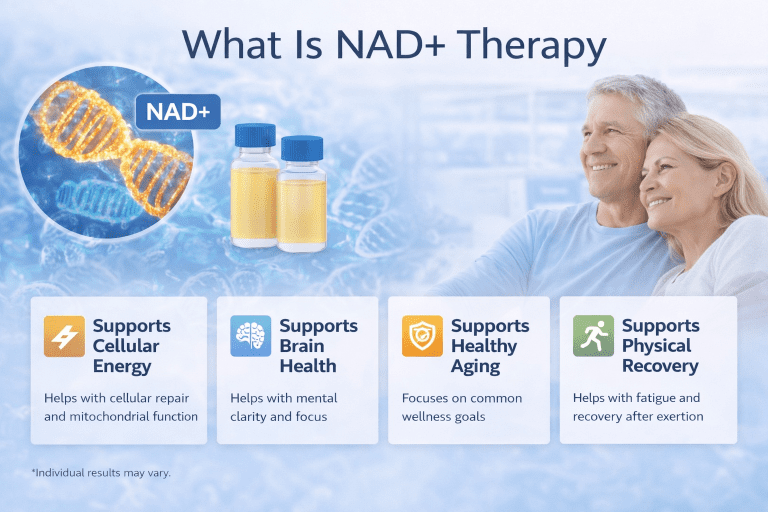
Patients often ask about NAD+ therapy when exploring options related to energy, mental clarity, physical recovery, and healthy-aging goals. However, research into injectable NAD+ for these outcomes is still developing, and individual results cannot be guaranteed.
At Quick Start Medical Weight Loss & Wellness, patients receive a personalized medical evaluation before treatment is recommended. This allows the provider to review the patient’s health history, current medications, treatment goals, potential risks, and available options.
What Is NAD+?
NAD+ stands for nicotinamide adenine dinucleotide. It is an essential coenzyme produced in the body using nutrients that include forms of vitamin B3.
NAD+ is present throughout cells, including the mitochondria, nucleus, and surrounding cellular fluid. It participates in processes involving energy metabolism, cellular signaling, and DNA repair.
Research suggests that NAD+ metabolism may change with age and certain health conditions. However, human evidence remains limited regarding whether administering NAD+ directly produces meaningful improvements in energy, cognition, recovery, metabolism, or healthy aging.
For this reason, NAD+ therapy should be discussed as an individualized wellness option rather than a treatment with guaranteed benefits.
Who May Be Interested in NAD+ Therapy?
Patients may ask about NAD+ therapy when exploring provider-guided support for goals related to:
- Energy
- Mental clarity
- Healthy aging
- Physical recovery
- Sleep and general wellness
- Stress-related fatigue
- Metabolic wellness
- Cellular health
NAD+ therapy is also commonly discussed by active individuals and patients who feel run down or are interested in additional wellness support.
Interest in a treatment does not necessarily mean it is appropriate for every patient. A medical provider should review the patient’s symptoms, health history, medications, treatment goals, and available evidence before recommending therapy.
Why Patients Ask About NAD+ Therapy
Patients often ask whether NAD+ therapy may support:
- Energy levels
- Focus and mental clarity
- Fatigue
- Recovery after physical activity
- Cellular energy processes
- Healthy aging goals
- General wellness and quality of life
NAD+ is an essential coenzyme involved in cellular energy metabolism and several other biological processes. However, the potential effects of administering NAD+ as a wellness treatment are still being studied.
Most human research has focused on oral NAD+ precursors such as nicotinamide riboside and nicotinamide mononucleotide rather than injected NAD+ itself. Studies have shown that some NAD+ precursors can increase NAD-related measurements in the body, but findings regarding energy, cognition, physical performance, metabolism, and other patient outcomes have been mixed.
For this reason, NAD+ therapy should be presented as an individualized wellness option rather than a treatment with guaranteed results.
How NAD+ Is Administered
At Quick Start Medical Weight Loss & Wellness, NAD+ may be administered through:
An intramuscular injection into a muscle such as the glute or deltoid
A subcutaneous injection placed into the tissue beneath the skin
The route, dosage, schedule, and duration of treatment will depend on the provider’s recommendation and the patient’s individualized care plan.
Patients should follow only the dosing and administration instructions provided directly by their medical provider.
What Is the Recommended Regimen?
Quick Start may use clinic-specific protocols such as:
NAD+ IM
Available in 50 mg and 100 mg doses. A provider may recommend two injections per week for at least four weeks, followed by an evaluation to determine whether maintenance treatment is appropriate.
NAD+ SQ
A provider may recommend 30 mg for 14 days, followed by a schedule of five days on treatment and two days off.
These are clinic protocols rather than universal dosing standards. The appropriate dose and schedule may vary based on the patient’s health, treatment response, medications, side effects, and provider assessment.
Patients should not begin, change, or continue a dosing schedule without instructions from their medical provider.
What Should You Tell Your Provider Before Starting?
Before beginning treatment, tell your provider about:
- All prescription and nonprescription medications
- Vitamins and dietary supplements
- Medication or ingredient allergies
- Previous reactions to injections or infusions
- Pregnancy, breastfeeding, or plans to become pregnant
- Current or previous cancer
- Liver or kidney conditions
- Heart, blood pressure, or blood sugar conditions
- Neurological or psychiatric conditions
- Any other chronic or uncontrolled medical condition
Patients with complex medical histories may need additional evaluation or clearance from another treating provider before beginning therapy.
Possible Side Effects
Possible reactions associated with injectable treatment may include:
- Soreness, redness, swelling, or irritation at the injection site
- Headache
- Nausea
- Temporary fatigue
- Flushing or warmth
- Dizziness
- Abdominal discomfort
FDA has also received adverse-event reports following the use of injectable NAD+ products. Reported reactions included severe chills, shaking, vomiting, and fatigue, with some patients requiring medical treatment. FDA stated that these reactions were consistent with excessive endotoxin levels associated with unsuitable ingredients used in sterile compounding.
Patients should contact their provider promptly if they experience concerning or persistent symptoms. Severe symptoms, difficulty breathing, chest pain, fainting, or signs of a serious allergic reaction require immediate medical attention.
What You May Notice After Treatment
Responses to NAD+ therapy can vary considerably. Some patients may report subjective changes in energy, focus, fatigue, or recovery, while others may notice little or no difference.
There is not currently enough high-quality human evidence to promise that a patient will experience specific benefits within 24 hours, one week, one month, or any other defined period. Research evaluating intravenous or intramuscular NAD+ itself for anti-aging and general wellness outcomes remains limited.
Your provider may evaluate treatment based on:
- Your symptoms and wellness goals
- Side effects or adverse reactions
- Changes you personally report
- Relevant health measurements
- Whether continued treatment remains medically appropriate
Treatment should be reconsidered when it does not provide a meaningful benefit, causes concerning side effects, or is no longer considered appropriate by the provider.
Is NAD+ Therapy Safe?
No medical treatment is completely without risk.
When NAD+ is provided as a compounded injectable medication, it is not FDA-approved. FDA does not review compounded medications for safety, effectiveness, or quality before they are marketed. Poor compounding practices may result in contamination or an incorrect amount of an active ingredient.
FDA has specifically warned compounders against using food-grade NAD+ ingredients to prepare sterile injectable products because of the risk of microbial or endotoxin contamination.
Patients considering NAD+ therapy should ask:
- Who compounded the medication
- Whether the pharmacy is properly licensed
- Whether the ingredients are suitable for sterile drug preparation
- How the medication should be stored
- What side effects should be reported
- What evidence supports treatment for their specific goals
- What alternative treatments are available
Treatment should be prescribed and monitored by a qualified medical provider after an individualized evaluation.
What Current Research Shows
NAD+ is essential to cellular energy metabolism and participates in biological processes involving cellular signaling, DNA repair, and metabolic regulation. NAD+ levels and metabolism may also change with age and certain health conditions.
Research into NAD+ restoration is promising, but it is important to distinguish among:
- NAD+ naturally present in the body
- Oral NAD+ precursors such as NR and NMN
- Intravenous NAD+ administration
- Intramuscular or subcutaneous NAD+ injections
Evidence from one form or route cannot automatically be applied to another.
Human studies involving oral NAD+ precursors have produced mixed results. Some have reported changes in NAD-related biomarkers or selected health measurements, while others have found no meaningful functional benefit. There remains a need for larger, longer, and better-controlled human trials.
Preclinical studies involving cells or animals can help researchers understand possible mechanisms, but they do not prove that injected NAD+ will produce the same outcome in people.
NAD+ Summary
NAD+ plays an important role in cellular energy and many normal biological processes. This has created interest in treatments intended to increase or restore NAD+ levels.
Patients commonly ask about NAD+ therapy for energy, mental clarity, recovery, healthy aging, and general wellness. However, evidence supporting injectable NAD+ for these outcomes is still developing, and results cannot be guaranteed.
The decision to use NAD+ therapy should be based on:
- A personalized medical evaluation
- A clear discussion of potential benefits and limitations
- Review of potential risks and side effects
- The quality and source of the compounded medication
- Ongoing provider monitoring
- Consideration of evidence-based alternatives
NAD+ Therapy in Pace, Florida
Patients interested in energy support, recovery, mental clarity, or healthy-aging goals may discuss NAD+ therapy during a consultation at Quick Start Medical Weight Loss & Wellness.
A provider can review your medical history, current medications, concerns, and treatment goals to determine whether NAD+ therapy or another wellness option may be appropriate.
Ready to get started? Schedule a consultation with Quick Start Medical Weight Loss & Wellness to learn more about available provider-guided wellness options.
References
- U.S. Food and Drug Administration: FDA Reminds Compounders to Use Ingredients Suitable for Sterile Compounding
- U.S. Food and Drug Administration: Compounding and the FDA, Questions and Answers
- Dietary Supplementation With NAD+-Boosting Compounds in Humans
- Evaluation of the Safety and Effectiveness of NAD+ and NADH Supplementation in Humans
- NAD+ Supplementation for Anti-Aging and Wellness
- NAD+ Metabolism and Its Roles in Cellular Processes During Ageing
Disclosure Statement
The information on this page is provided for educational purposes only and is not a substitute for medical advice, diagnosis, or treatment.
Compounded medications are not FDA-approved. FDA does not verify the safety, effectiveness, or quality of compounded medications before they are marketed.
Statements concerning dietary supplements, wellness products, medications, or injections may not have been evaluated by FDA. No product or treatment is intended to diagnose, treat, cure, or prevent a disease unless specifically approved for that purpose.
Treatment results vary, and no result is guaranteed. Patients should use medications, supplements, and wellness treatments only under the guidance of a qualified medical provider. All treatments carry potential risks, and patients should discuss those risks, available evidence, and alternative options before beginning treatment.